Aegisify company logo
Learn About Aegisify Secure Audit Services – Audit your WordPress Website, Application or Commerce Website today!2026-08-11T22:14:29+00:00
WordPress Security Audit

Find the signal. Filter the noise. Act with evidence.

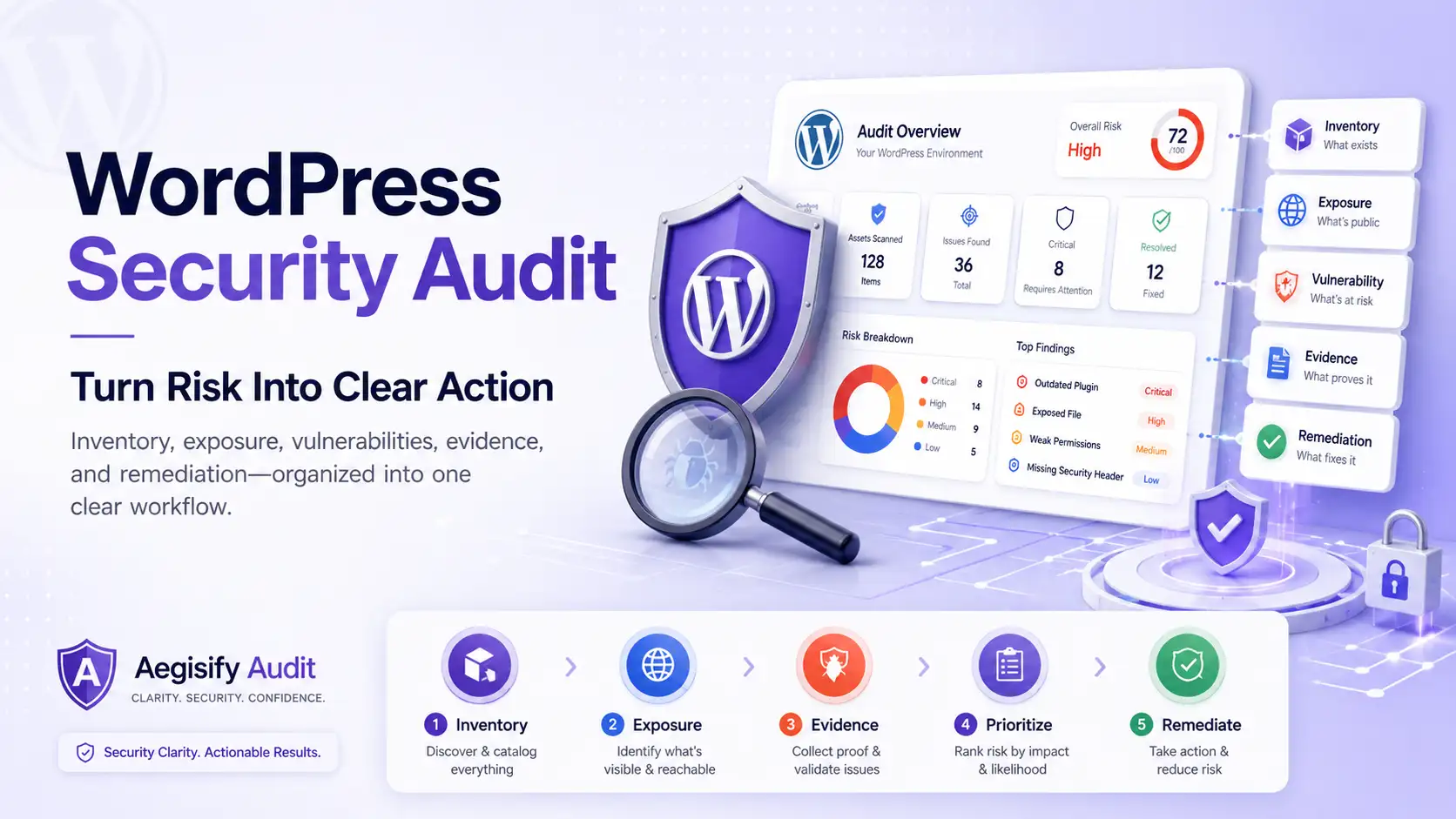
Aegisify Audit is a SaaS WordPress security audit and risk intelligence platform built for serious website inspection and site visibility.

Aegisify Audit combines external application testing with evidence collected by the connected Aegisify Agent inside WordPress. Together, they help organizations identify vulnerable software, exposed application routes, insecure configurations, code-level weaknesses, unexpected changes, operational risks, recovery gaps, and WooCommerce-specific concerns.

Instead of creating another disconnected list of alerts, Aegisify Audit brings findings into one organized workflow so teams can understand what changed, what matters most, what should be investigated first, and whether corrective actions improved the environment.

  • WordPress security audit
  • Risk intelligence platform
  • Vulnerable software detection
  • Configuration drift
  • WooCommerce security
  • AI-assisted prioritization
Aegisify Audit
Inspecting risk
See WordPress risk from the outside in. External scans show what the public application exposes. The Aegisify Agent reveals deeper evidence from inside WordPress.
Outside view
  • Exposed application routes
  • Public attack surface
  • External application testing
Inside view
  • Plugin and software risk
  • Configuration evidence
  • Unexpected changes and drift
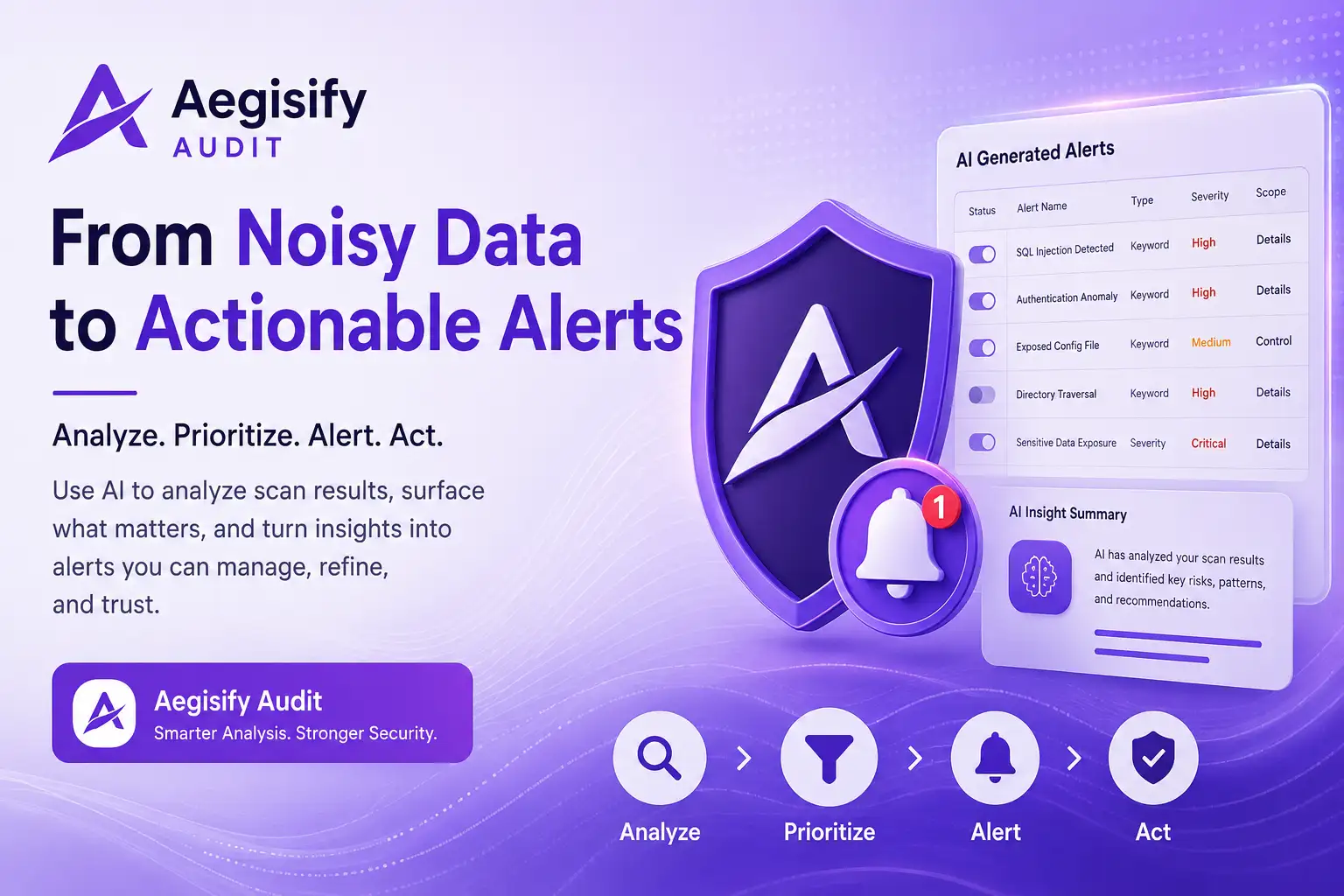
Organized workflow AI helps prioritize what deserves attention first. Bring both views together to investigate risk faster, reduce noise, and make corrective action easier to evaluate.
Built for WordPress site inspectors, security-conscious operators, agencies, ecommerce teams, and organizations that need clear evidence.
Aegisify Purple Scroll Orbit Preview
See the signal

Find the signal.
Across your entire WordPress environment.

External exposure, code, configuration and activity evidence—correlated in one clear view.

WordPress Security Risk

Your WordPress Site Can Look Healthy and Still Carry Risk

A working homepage does not confirm that an outdated component is not exposed through a public endpoint.

A clean plugin dashboard does not reveal whether custom code or an integration contains an authorization weakness.

A recent update does not confirm that files, settings, scheduled tasks, or privileged accounts have not changed unexpectedly.

A long list of security warnings also does not tell your team what to investigate first.

Aegisify Audit connects external exposure, internal WordPress evidence, software risk, code findings, activity, and operational change into a clearer security workflow.

Connected WordPress Evidence

One Platform. Two Views of Your WordPress Environment.

External Application View

Assess the public website, application routes, login surface, APIs, forms, browser assets, security headers, and other reachable services.

See the environment as an external request sees it without relying only on what WordPress reports internally.

Internal Agent View

Connect the encrypted Aegisify Agent to collect authorized WordPress evidence about software, configuration, permissions, code, dependency manifests, file changes, activity, and application health.

Connected Risk View

Bring both evidence sources into one domain-level dashboard.

Review what is exposed, what exists internally, what changed, what may be vulnerable, and what should be verified next.

Live evidence pipeline

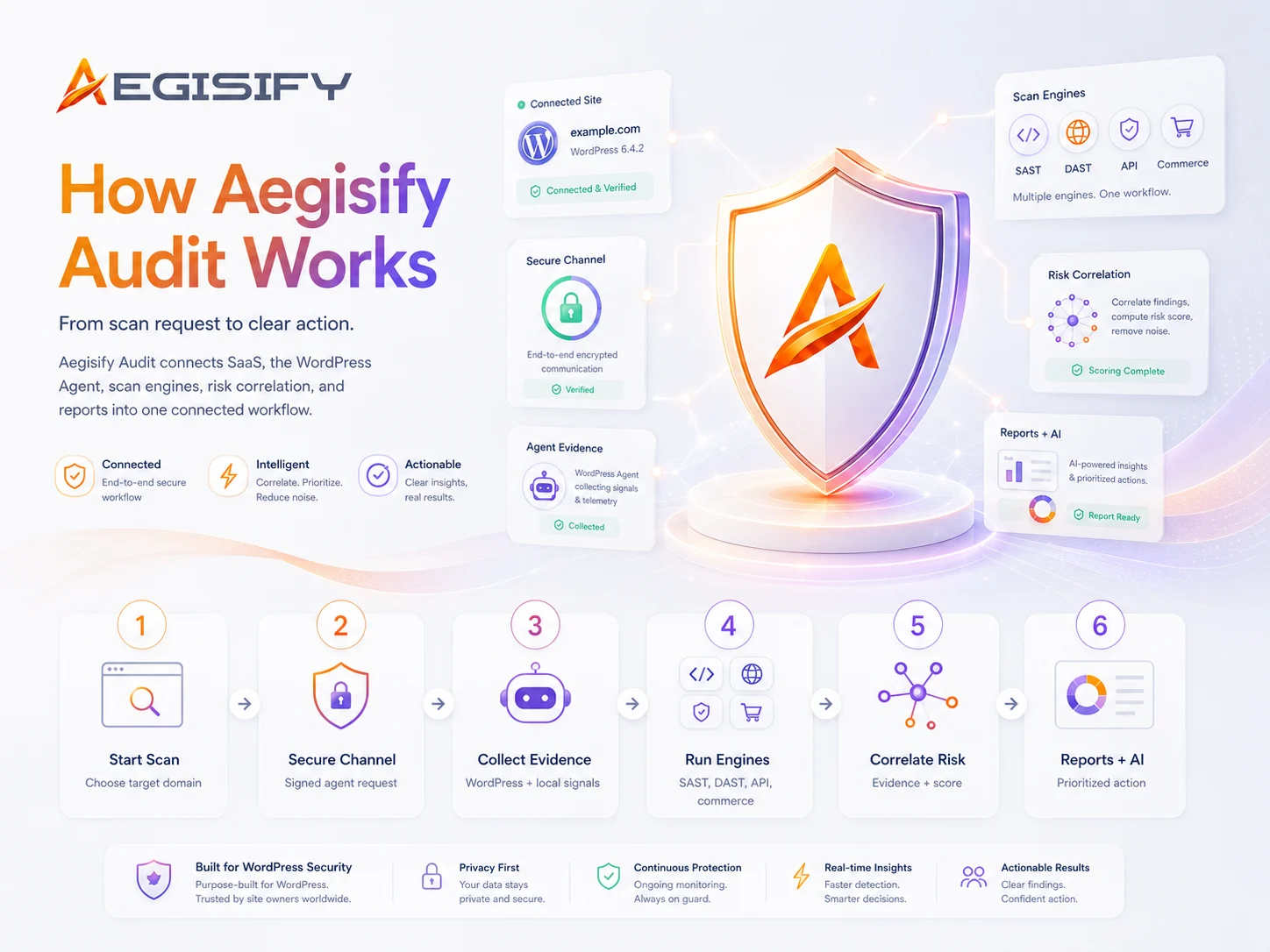
Aegisify Audit SaaS to WordPress Agent Scan Workflow

Verified Domain Secure Agent Collection Scan Engines Evidence AI Triage Reports
01 SaaS Starts Scan Verified target domain Scan profile selected Scan ID + queued job
02 Secure Channel HTTPS REST request Security key + signature Nonce / replay guard
03 Agent Collects Core, plugins, themes Config + dependencies Logs + commerce signals
04 Scan Engines SAST + vulnerability review DAST + API discovery WooCommerce checks
05 Risk Correlates OWASP context CVE / OSV / KEV / EPSS Evidence + risk score
06 Reports + AI Top 10 Threats AI-assisted guidance CSV / PDF / XML exports
AI Orchestration SaaS Starts Scan Verifying the target domain and binding a unique scan job. Confidence99%
Important scan details only

Commerce + App Flows

  • Cart, checkout, Store API, payment paths
  • Webhooks, HPOS, Action Scheduler posture
  • Order ownership and privacy signals
  • Revenue-impacting abuse indicators

Prioritized Outputs

  • Findings with evidence and affected asset
  • Severity, confidence, risk score, scan deltas
  • Remediation status and verification notes
  • Dashboard AI, Top 10 Threats, reports

Persistent Data Lifecycle

Every result stays tied to the account, target domain, scan job, evidence, risk score, remediation state, and exportable report.

Account User Target Domain Scan ID / Job Agent Payloads Assets + APIs Findings + Evidence Risk Score AI Triage Reports
WordPress Security Audit & Risk Intelligence

See the WordPress risk your plugin dashboard cannot show.

Aegisify Audit combines a verified external WordPress security scan with an authorized WordPress Agent to inspect application code, dependencies, OWASP-aligned web and API exposure, WooCommerce business flows, site changes, logs, and supporting evidence. Security executives see business priorities. IT teams get the technical facts needed to investigate, coordinate security controls across the Aegisify suite, and verify corrective action.
Outside-in exposure Inside WordPress evidence Business-risk context Human-reviewable guidance
Know what runs inside the WordPress environment before it becomes a blind spot. The authorized Agent inventories core, plugins, themes, MU-plugins, Composer, npm, and PyPI packages, then connects versions, provenance, known vulnerability evidence, integrity drift, and change history. Leaders gain asset accountability; administrators get a precise investigation list. Software inventoryDependency riskChange visibility Review the evidence model
Review application logic that outside-only scanners cannot see. Agent-authorized static analysis examines WordPress code quality, PHPCS/WPCS signals, custom PHP, JavaScript and supported Python rules, secrets, malware indicators, nonces, capabilities, and REST/AJAX authorization. Prioritize code paths that can affect sensitive data, privileges, transactions, or uptime. Static analysisAuthorization reviewCode evidence Explore application security
Test the public WordPress application as an attacker-facing surface—not only as a plugin inventory. Quick DAST, Enterprise DAST: App & Commerce, Deep Auth DAST, and API DAST review routes, headers, cookies, forms, REST, OpenAPI, GraphQL, sessions, and authorization boundaries with evidence tied to each finding. Public exposureAPI discoveryAuth boundaries See the scan workflow
Follow the business flow from cart to order instead of treating WooCommerce as another plugin. Review Store API, checkout blocks, payment paths, webhooks, HPOS, Action Scheduler, order ownership, privacy, templates, extensions, and abuse signals that can become revenue loss, fraud exposure, operational failure, or damaged customer trust. Revenue pathsOrder integrityCommerce operations Review commerce coverage
Give executives the decision view and administrators the technical proof. Correlate findings with the affected asset, evidence, severity, confidence, threat intelligence, scan deltas, remediation status, and verification notes. Use human-reviewable AI triage and CSV, PDF, or XML reports to decide what to fund, fix, and verify first. Prioritized riskHuman reviewDefensible reporting See facts and proof
Asset Intelligence / Verified DomainWordPress & Dependency Inventory
Inventory Connected
Evidence sourceAgentAuthorized local collection
Software layers7Core through dependencies
Risk signalsLinkedVulnerability + provenance
Site changeTrackedAdded, removed, changed
WordPress Software Map
Inventory, versions, provenance, and change evidence
Inside View
WPCore + runtime
PL
PluginsActive + MU
TH
ThemesActive + parent
CP
ComposerPHP packages
JS
npmJS packages
PY
PyPIPython packages
Dependency Risk Intelligence
Evidence attached to the affected component
Correlated
CV
Known vulnerability matchingCVE, OSV and WordPress-focused evidence
Mapped
KE
Exploit and likelihood contextKEV and EPSS signals where available
Context
DR
Inventory driftAdded, removed, or version-changed software
Tracked
IN
Integrity and support signalsMismatch, inactive, abandoned, or unsupported risk
Review
Leadership answer: What software exists, what changed, and which components deserve action?Replace assumptions and screenshots with domain-bound inventory and evidence that technical teams can investigate.
Asset accountability
1 / 5

Get the knitty gritty details of Aegisify WordPress Audit workflow.

Understand the steps how Aegisify Audit connects its SaaS platform with a secure WordPress Agent to collect evidence, analyze risk, correlate findings, and turn complex scan data into clear, prioritized action.

A diagram illustrating the Aegisify service workflow process.
A person using a laptop to sign up for an account on a website.

Got Questions? We got Answers.

Still need answers, please contact us today!

Learn more about Aegisify Audit