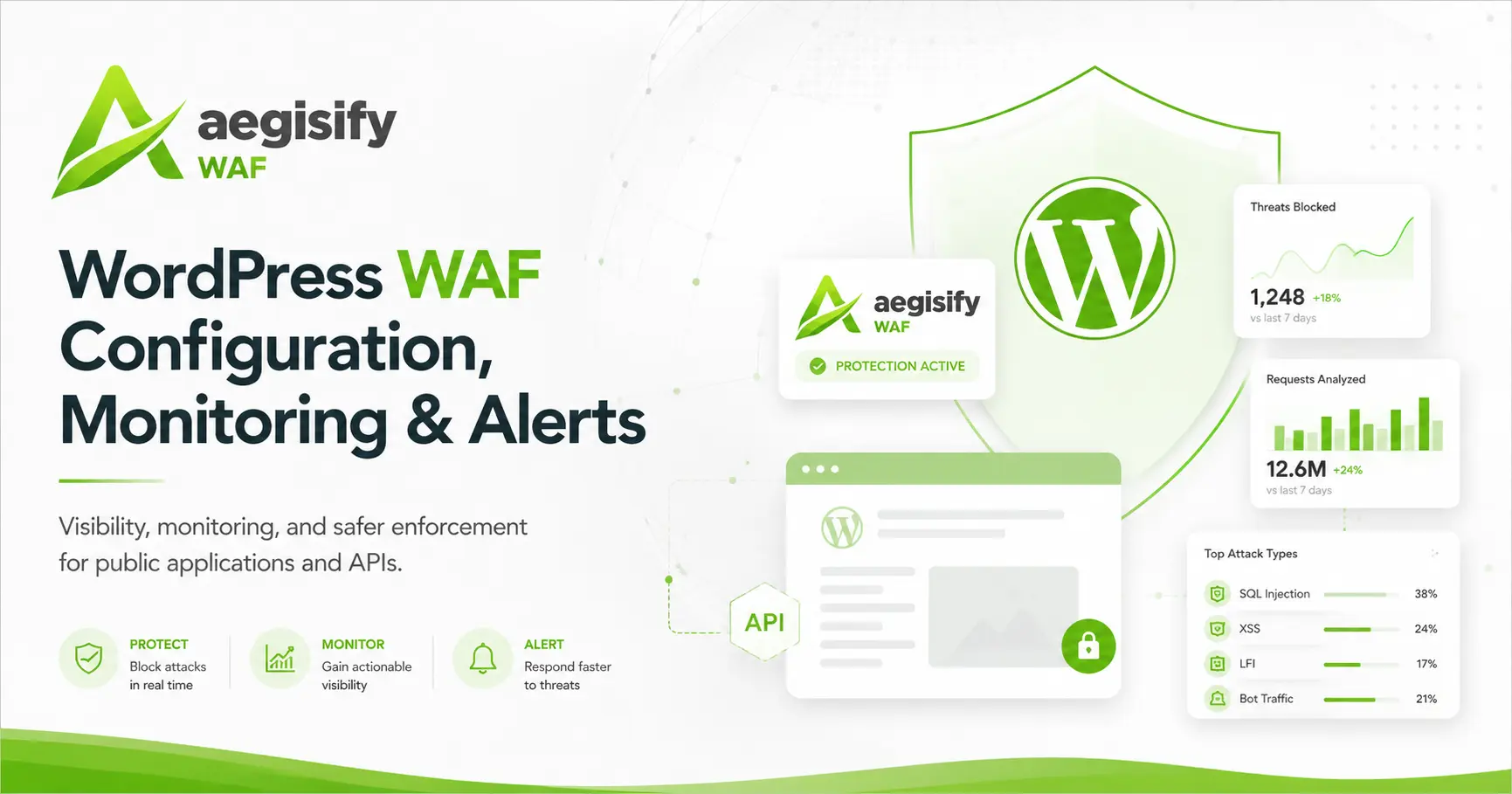
Understand, monitor, and control WordPress request risk without losing sight of legitimate users, APIs, integrations, and business-critical routes.
Aegisify WAF is a WordPress web application firewall built for application-aware protection. It combines early request inspection, high-confidence managed rules, REST and AJAX monitoring, risk-scored enforcement, bot and authentication defenses, application-layer DDoS controls, block and white list management, detailed evidence, encrypted inventory, configuration recovery, and AI-assisted WAF mapping.
Core protection is available first. Protected operational workflows activate with an eligible Aegisify subscription.


How can Aegisify AI help?
Ask about Aegisify or WordPress: errors, plugins, security, SEO, compatibility, troubleshooting, comparisons, or launch a free website scan.
Understand, monitor, and control WordPress request risk without losing sight of legitimate users, APIs, integrations, and business-critical routes.
Aegisify WAF is a WordPress web application firewall built for application-aware protection. It combines early request inspection, high-confidence managed rules, REST and AJAX monitoring, risk-scored enforcement, bot and authentication defenses, application-layer DDoS controls, block and white list management, detailed evidence, encrypted inventory, configuration recovery, and AI-assisted WAF mapping.
Core protection is available first. Protected operational workflows activate with an eligible Aegisify subscription.
WordPress Plugins: AegisShield | Aegisify WAF | AegisSEO | AegisSpam | AegisLink | AegisSiteMap | AegisBackup
Aegisify WAF Capabilities
Protect WordPress requests, APIs, authentication, dynamic routes, crawlers, and configuration with separate controls for integrity, attack detection, monitoring, enforcement, evidence, recovery, and application-aware tuning.
Monitor what is uncertain. Block what is high-confidence. Keep compatibility exceptions narrow. Verify changes and preserve rollback where supported.
Web Application Firewall
Inspect WordPress requests early with request normalization, integrity checks, managed attack rules, custom policy, endpoint controls, and reviewable enforcement modes.
Request Integrity
Reject malformed URI encoding, null bytes, ambiguous HTTP framing, dangerous methods, excessive headers, and executable or double-extension upload filenames.
Managed Attack Protection
Detect SQLi, NoSQL injection, XSS, traversal, LFI/RFI, RCE, command injection, SSRF, and risky upload behavior with high-confidence application-layer controls.
Managed Rules
Use the bounded Balanced or Strict signature library, zone-specific inspection, category thresholds, anomaly scoring, and rule-level evidence to tune protection deliberately.
Heuristic Threat Analysis
Score deterministic request anomalies such as encoding density, metacharacters, suspicious tokens, path behavior, entropy, and abnormal input structure without presenting heuristics as machine learning.
API Shield & Endpoint Policy
Inventory REST and AJAX activity, validate supported OpenAPI contracts, and configure authentication, identity rate limits, payload boundaries, GraphQL, BOLA compensating controls, and per-route enforcement.
App Monitor & Alerts
Monitor selected application URLs in Monitor, Monitor & Alert, or Risk Score Enforcement modes with evidence thresholds, decision reasons, and administrator-controlled escalation.
Authentication Defense
Correlate credential stuffing and password spraying from both directions, create temporary source bans, and use keyed account fingerprints instead of storing raw usernames or passwords.
Bot & Crawler Control
Manage abusive automation, recognized crawlers, per-path request pressure, User-Agent policy, crawler compatibility, IP/CIDR controls, and geographic/network-owner policy.
Layer 7 DDoS Controls
Use progressive challenge, rate-limit, and temporary-block thresholds for high-cost WordPress routes such as login, REST, admin-ajax, XML-RPC, search, cron, and cache-bypass traffic.
Progressive Challenge + GeoIP/ASN
Combine explicit country or ASN policy, anonymous behavioral evidence, sensitive-route context, and signed browser challenges without treating geography as proof of malicious intent.
Block / White List
Review temporary bans, release legitimate sources, create permanent IPv4, IPv6, or CIDR blocks, import validated lists, view country context, and maintain narrow trusted-traffic allowances.
Real-Time WAF Logging
Retain structured application-security events with module, route, action, reason, severity, source context, continuity mirrors, dashboards, retention, and aggregated alerting.
Attack Story
Correlate retained WAF, API, bot, DDoS, authentication, and enforcement evidence into investigation windows showing targeted routes, threat families, sources, rules, methods, and outcomes.
Overview & Decision Metrics
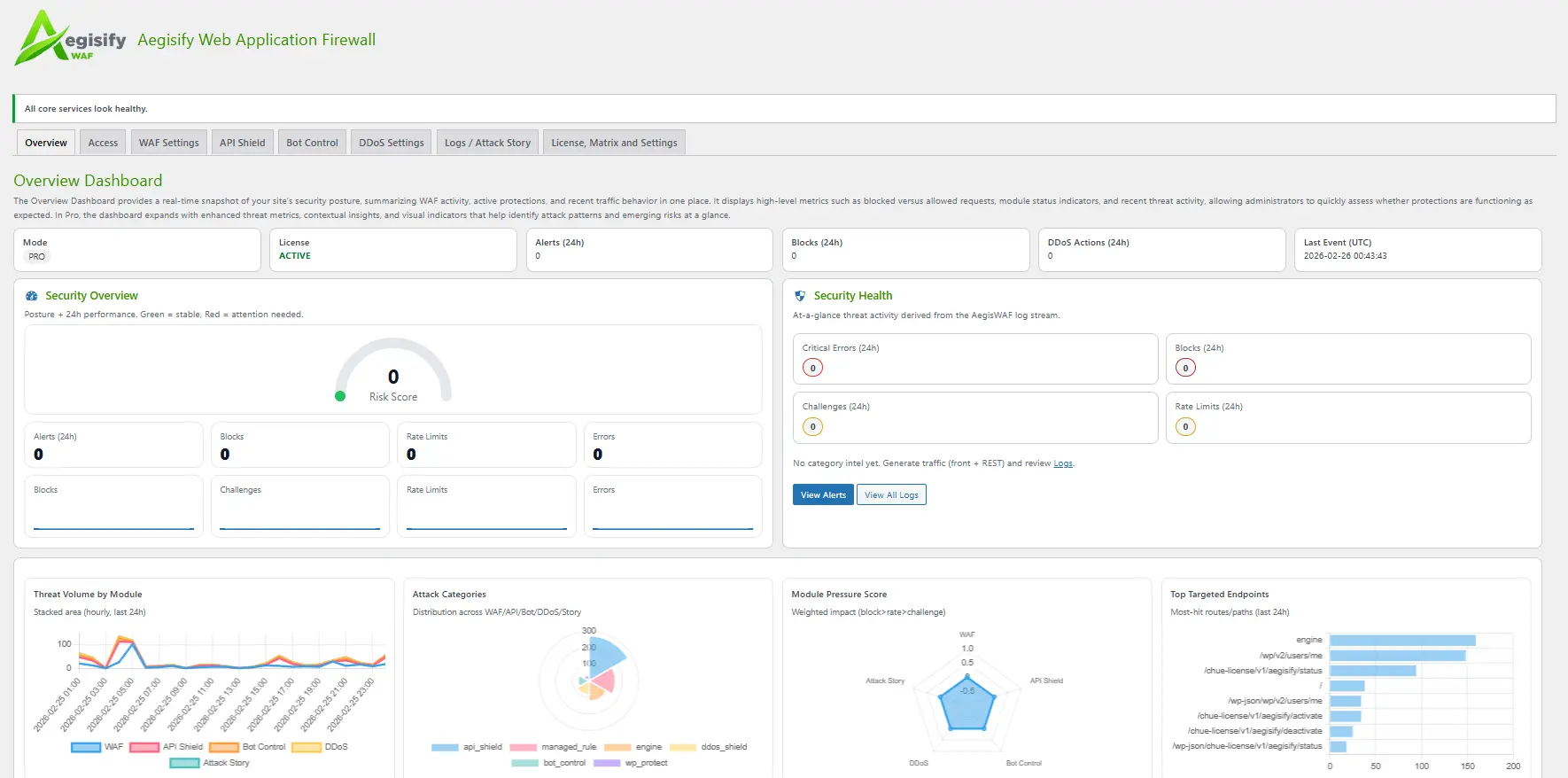
Review enforcement trends, threat families, module pressure, target endpoints, methods, sources, health, alerts, and weighted activity signals without reducing WAF posture to one number.
Configurations, Inventory & AI
Back up durable WAF settings, scan an encrypted local attack-surface inventory, review deterministic findings, authorize redacted AI-assisted mapping, apply guarded low-risk changes, verify writes, and roll back when supported.
It combines protocol integrity, attack signatures, application and API monitoring, authentication and bot defenses, Layer 7 controls, evidence, source operations, configuration recovery, and guarded AI-assisted planning in one WordPress-aware security workflow. No single control guarantees protection; the value is in how the layers remain visible, tunable, and recoverable.
Monitor – Evaluate – Enforce – Tune
Ready to See What Your WordPress Application Is Exposing?
Start with core WAF protection, or activate an Aegisify subscription for protected operational workflows including API Shield, App Monitor & Alerts, Block / White List, Configurations, inventory, and AI-assisted WAF planning.
Core Protection and Subscription Workflows
Local WordPress protection stays active at the application layer. Subscription workflows extend visibility, administration, recovery, and advanced policy control through the shared Aegisify entitlement model.
Core Protection
Inspect malformed or ambiguous requests before normal WordPress processing.
Apply core application-layer defenses against recognized attack patterns.
Manage core settings, access controls, basic bot controls, overview metrics, and event visibility.
Keep core request inspection and enforcement inside WordPress.
Aegisify Subscription Workflows
Apply deeper API visibility, route policies, and endpoint-aware controls.
Monitor selected application URLs and use administrator-controlled risk-score enforcement.
Manage temporary bans, permanent IPv4/IPv6/CIDR blocks, imports, releases, and country context.
Use encrypted inventory, configuration backup, verified restore, rollback, and guarded AI-assisted WAF planning.
Extend geo/ASN controls, logs, exports, tuning depth, and Attack Story investigation workflows.
Test the Full Aegisify WAF Workflow
Start with core local protection, then evaluate the advanced administration, visibility, and recovery workflows available through the subscription.
Aegisify WAF — Application-Aware Protection for Serious WordPress Sites
Aegisify WAF (Web Application Firewall)
Protect WordPress at the Application Layer With Evidence Before Enforcement.
WordPress sites now run stores, portals, forms, APIs, memberships, dashboards, and custom applications. Aegisify WAF inspects requests early, maps traffic to the application surface, and separates monitoring, alerting, and blocking so teams can protect production workflows without treating every unusual request as proof of an attack.
01.
Early Request Inspection
Checks request integrity, methods, paths, headers, query data, bodies, cookies, and uploads before normal WordPress page handling completes.
02.
Correlated Security Signals
Combines managed signatures, request context, authentication abuse, endpoint policy, rate controls, and behavioral history without turning every heuristic into an automatic block.
03.
Application & API Monitoring
Inventories and monitors WordPress REST routes, public and authenticated AJAX actions, and selected application URLs with separate alert and enforcement controls.
04.
Reviewable Enforcement
Shows scores, evidence counts, matched signals, decision reasons, temporary bans, permanent blocks, country context, and administrator recovery actions.

Application-aware protection for WordPress sites, APIs, integrations, and custom workflows
A WordPress WAF Built Around Visibility, Control, and Recovery
Aegisify WAF evaluates requests during the WordPress lifecycle, applies protocol-safety checks and high-confidence attack rules, records suspicious behavior, and gives administrators a controlled path from monitor-only visibility to alerting and risk-scored enforcement.