Many WordPress website owners hear terms such as DAST, SAST, dependency risk, code quality, application security, and vulnerability scanning and assume they only apply to software developers.
They do not.
You do not need to be building a custom application to face software-related risk. WordPress is software, and every theme, plugin, form, user account, integration, ecommerce tool, and administrative setting becomes part of your broader technology environment.
Popular WordPress extensions can contain coding defects, outdated dependencies, security vulnerabilities, configuration weaknesses, and compliance concerns. The more components your website relies on, the more important it becomes to understand how they interact and where risk may exist.
Whether you operate a personal blog, business website, membership portal, customer platform, or WooCommerce store, you need visibility into what is running, what is exposed, what has changed, and what requires attention.
More Than a Basic WordPress Security Scan
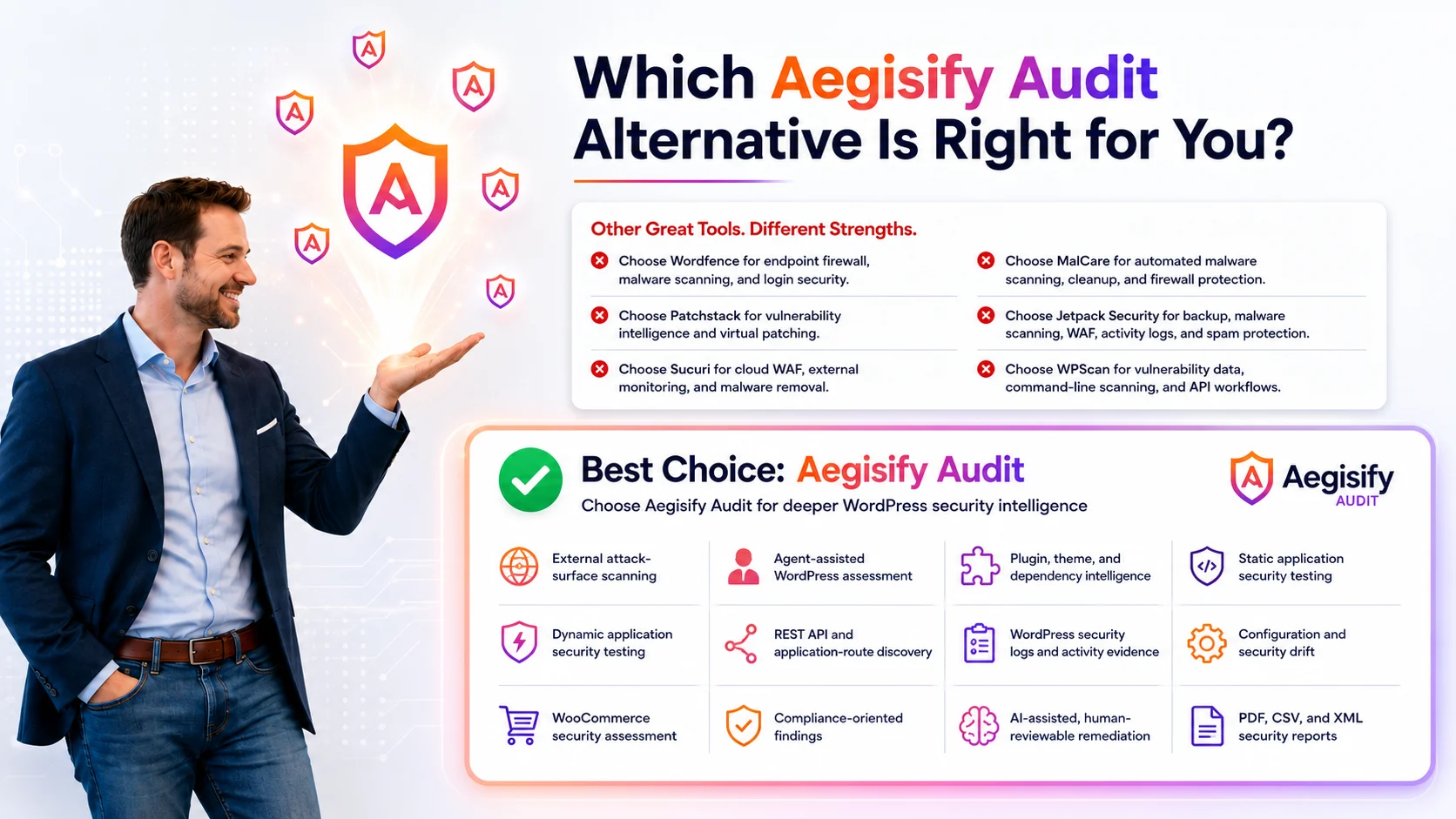
Aegisify Audit is designed for teams that need more than a collection of disconnected alerts. It provides a structured view of the WordPress environment, helping security professionals evaluate activity, exposure, software risk, configuration weaknesses, and operational evidence in context.
| Operational Visibility | |
|---|---|
| User and Administrative Activity | Review authentication events, user movement, privileged actions, and configuration changes across the WordPress environment. |
| Application and WordPress Logging | Centralize relevant events from WordPress, plugins, integrations, and supporting applications to improve investigation, event correlation, and operational analysis. |
| Change Awareness | Identify material changes to users, plugins, themes, settings, files, and other components that may affect the website’s security posture. |
| Vulnerability and Software Risk | |
|---|---|
| Known Vulnerability Detection | Identify WordPress core, plugins, themes, and dependencies associated with publicly disclosed security vulnerabilities. |
| Plugin and Theme Assessment | Review installed components, version status, maintenance concerns, and software that may require remediation, replacement, or additional investigation. |
| Code and Dependency Analysis | Surface potential weaknesses within custom code, extensions, third-party libraries, and supporting software packages. |
| Application Security Indicators | Evaluate findings associated with insecure implementation patterns, exposed functionality, dependency risk, code defects, and the broader application attack surface. |
| Configuration and Exposure Management | |
|---|---|
| Security Configuration Review | Detect weak settings, excessive permissions, exposed services, incomplete safeguards, and controls that may be incorrectly configured. |
| External Exposure Analysis | Assess publicly observable information, accessible endpoints, security headers, domain signals, and other indicators visible to an external party. |
| Authentication and Attack Activity | Review suspicious login behavior, repeated access attempts, security events, and possible indicators of automated, credential-based, or targeted attacks. |
| Business-Critical WordPress Functions | |
|---|---|
| WooCommerce and Ecommerce Risk | Evaluate the environment supporting customer accounts, products, orders, payment workflows, ecommerce extensions, and third-party integrations. |
| SEO and Website Visibility | Identify technical conditions that may affect crawling, indexing, canonicalization, structured data, content discovery, and search-engine visibility. |
| Integration Awareness | Review connected services, APIs, forms, automation tools, payment systems, and external platforms that expand the application boundary and introduce additional dependencies. |
Evidence-Driven Reporting
Aegisify Audit converts technical findings into structured reports that can be reviewed across security, engineering, operations, compliance, agency, and business teams.
The result: a more defensible and actionable view of WordPress risk that supports investigation, triage, remediation planning, validation, and informed security decision-making.